
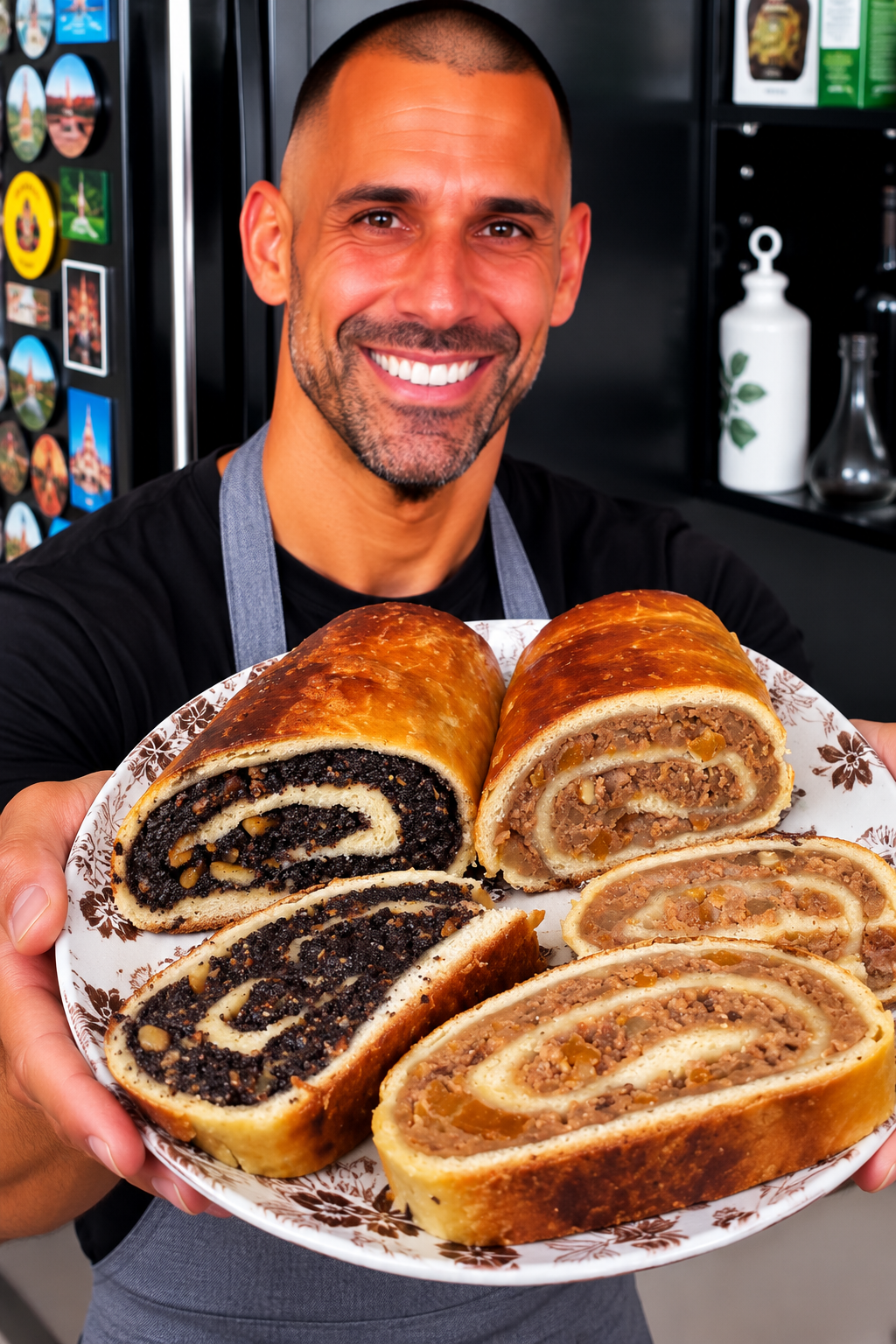
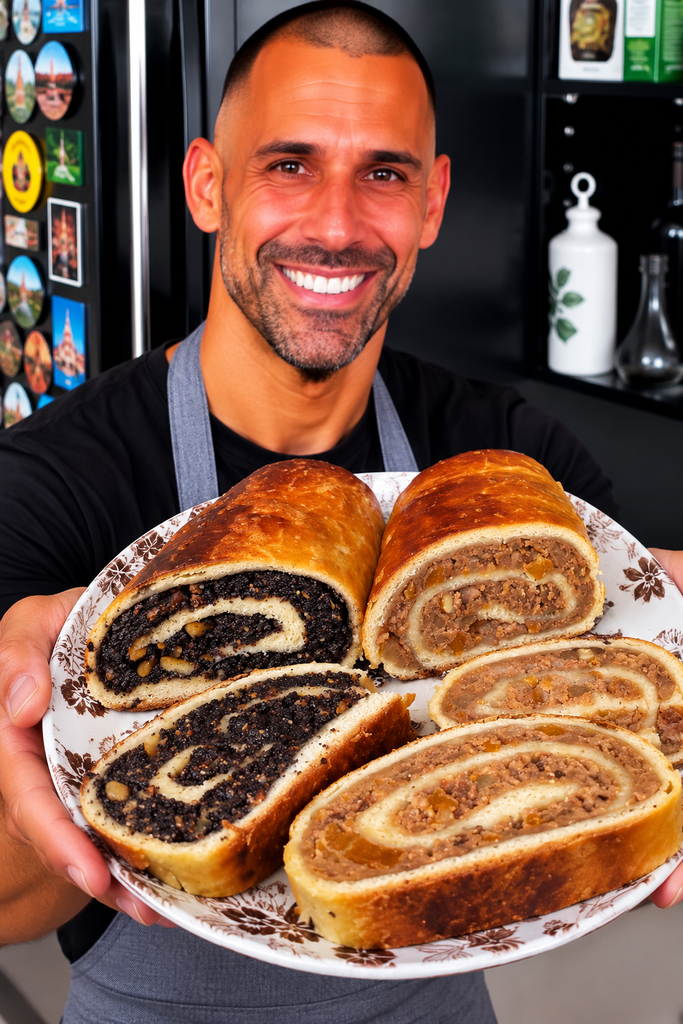
Traditional Hungarian Beigli, also known as Bejgli, is one of Hungary’s most beloved Christmas pastries, featuring delicate, buttery yeast dough wrapped around rich, sweet fillings of ground walnuts or poppy seeds. With its beautiful spiral layers, fragrant citrus zest, and distinctive golden marbled crust, this old-fashioned Hungarian dessert has been a cherished holiday tradition for generations.
Imagine stepping into Grandma’s kitchen just before Christmas. The warm aroma of freshly baked pastry, sweet walnuts, ground poppy seeds, vanilla, and lemon zest fills the house.
On the kitchen table sit two beautiful homemade rolls. One is filled with fragrant walnuts, while the other contains a rich, dark poppy seed filling.
Each roll is carefully sliced, revealing beautiful spirals of tender pastry and delicious filling.
For many Hungarian families, Christmas simply wouldn’t feel complete without homemade Diós Bejgli and Mákos Bejgli.
Whether you’re continuing a treasured family tradition or discovering Hungarian Christmas baking for the first time, this authentic-style Beigli recipe is a wonderful addition to your holiday dessert collection.
Today, we’re sharing a traditional Hungarian Beigli recipe with both classic fillings, detailed baking instructions, Grandma’s special tips, and the secrets to achieving the famous marbled crust.
What Is Traditional Hungarian Beigli?
Beigli, more commonly spelled Bejgli in modern Hungarian, is a traditional rolled pastry made with rich, buttery yeast dough and a generous sweet filling.
It is especially popular during Christmas, although many Hungarian families also prepare it for Easter and other special celebrations.
Unlike ordinary bread rolls, Beigli has a tender, slightly crumbly pastry texture rather than a light, fluffy bread texture.
The filling is usually spread generously across thinly rolled dough, which is then rolled into a long log and baked until golden brown.
When sliced, the pastry reveals beautiful spirals of filling surrounded by delicate layers of dough.
There are two especially traditional varieties.
Diós Bejgli – Hungarian Walnut Roll
Diós Bejgli is filled with finely ground walnuts, sugar, honey, milk, and fragrant lemon zest.
Some family recipes also include cinnamon, raisins, or vanilla.
The filling is rich, aromatic, and wonderfully nutty.
Mákos Bejgli – Hungarian Poppy Seed Roll
Mákos Bejgli is made with finely ground poppy seeds, sugar, milk, and citrus zest.
Its dark filling has a distinctive nutty, earthy flavor that contrasts beautifully with the lightly sweet pastry.
Both varieties are traditionally served together during Hungarian Christmas celebrations.
Why You’ll Love This Hungarian Beigli Recipe
- Traditional Hungarian Christmas flavor: A classic holiday pastry cherished for generations.
- Two delicious fillings: Make both walnut and poppy seed rolls using the same dough.
- Beautiful spiral slices: Every piece reveals impressive layers of rich filling.
- Tender, buttery pastry: A delicate dough that complements the sweet fillings perfectly.
- Famous marbled crust: Traditional egg glazing produces an elegant, golden finish.
- Perfect for preparing ahead: Beigli keeps well and can be baked before Christmas.
- Wonderful homemade gift: Beautifully wrapped rolls make thoughtful holiday presents.
- Family-friendly tradition: A rewarding recipe to prepare and share with loved ones.
Recipe Overview
- Preparation Time: 45 minutes
- Dough Chilling Time: 60 minutes
- Glazing and Resting Time: 40–60 minutes
- Baking Time: 35–45 minutes
- Cooling Time: Approximately 2 hours
- Total Time: Approximately 5–6 hours
- Yield: 2 medium Beigli rolls (1 walnut and 1 poppy seed)
- Servings: Approximately 16–20 slices
- Difficulty: Intermediate
- Cuisine: Hungarian
- Course: Dessert
- Cooking Method: Baking
Ingredients for Traditional Hungarian Beigli
The secret to delicious homemade Beigli is using fresh walnuts, finely ground poppy seeds, good-quality butter, and carefully prepared filling.
For the Traditional Beigli Dough
- 4 cups (500 g) all-purpose flour
- ¾ cup plus 2 tablespoons (200 g) unsalted butter, cold and cubed
- ½ cup (60 g) powdered sugar
- 2 large egg yolks
- ½ cup plus 1 tablespoon (140 ml) lukewarm milk
- ¼ cup (60 g) sour cream
- 2¼ teaspoons (7 g) instant yeast
- 1 teaspoon vanilla extract
- ½ teaspoon salt
For the Walnut Filling (Diós Töltelék)
- 2 cups (200 g) finely ground walnuts
- ⅓ cup plus 1½ tablespoons (85 g) granulated sugar
- ⅓ cup plus 1 tablespoon (100 ml) milk
- 1 tablespoon (25 g) honey
- Zest of ½ lemon
- ½ teaspoon ground cinnamon
- ½ teaspoon vanilla extract
- 2 tablespoons raisins, optional
For the Poppy Seed Filling (Mákos Töltelék)
- 1¾ cups (200 g) finely ground, culinary-grade poppy seeds, approximately
- ⅓ cup plus 1½ tablespoons (85 g) granulated sugar
- ½ cup (120 ml) milk
- 1 tablespoon (25 g) honey
- Zest of ½ lemon
- ½ teaspoon vanilla extract
- 2 tablespoons raisins, optional
For the poppy seeds, use the weight measurement because volume varies considerably depending on the grind.
For the Traditional Marbled Egg Glaze
- 1 large egg, separated into yolk and white
Ingredient tip: Freshly ground walnuts and poppy seeds provide the best flavor. Old nuts and seeds can develop a bitter or stale taste, so choose fresh ingredients whenever possible.
How to Make Traditional Hungarian Beigli
Follow these step-by-step instructions to create two beautiful Christmas rolls with tender pastry, generous filling, and a traditional marbled crust.
Step 1: Prepare the Dough Ingredients
Start by measuring all the dough ingredients carefully.
Cut the cold butter into small cubes.
Warm the milk until lukewarm, approximately 95–100°F (35–38°C).
The milk should feel comfortably warm, not hot.
If using instant yeast, you can mix it directly with the flour.
If using active dry yeast instead, dissolve it in the lukewarm milk and allow it to become foamy before using.
Step 2: Combine the Dry Ingredients
In a large mixing bowl, combine the flour, powdered sugar, instant yeast, and salt.
Mix until evenly distributed.
Add the cold butter cubes.
Using your fingertips or a pastry cutter, work the butter into the flour until the mixture resembles coarse breadcrumbs.
This technique helps create the tender, slightly crumbly texture associated with traditional Hungarian Beigli.
Step 3: Add the Wet Ingredients
Add the egg yolks, lukewarm milk, sour cream, and vanilla extract.
Mix with a wooden spoon until the ingredients begin to form a dough.
Transfer the dough to a lightly floured work surface.
Knead gently for approximately 3–5 minutes, just until it becomes smooth and cohesive.
Unlike traditional bread dough, Beigli dough should not be kneaded excessively.
The finished dough should feel soft, rich, and easy to handle without being overly sticky.
Step 4: Divide and Chill the Dough
Divide the dough into two equal portions.
Shape each portion into a flat rectangle.
Wrap tightly in plastic wrap.
Refrigerate for approximately 60 minutes.
Chilling helps the butter firm up and makes the pastry easier to roll.
While the dough chills, prepare both traditional fillings.
How to Make the Hungarian Walnut Filling
Step 5: Prepare the Walnuts
Place the walnuts in a food processor.
Pulse until finely ground.
Avoid processing too long, as the walnuts can release their oils and become a paste.
The finished walnuts should have a texture similar to coarse flour.
Set aside while preparing the syrup.
Step 6: Heat the Milk, Sugar, and Honey
Pour the milk into a medium saucepan.
Add the sugar and honey.
Heat gently over medium-low heat, stirring until the sugar dissolves.
Bring the mixture to a gentle simmer.
Avoid boiling excessively.
Step 7: Combine the Walnut Filling
Remove the saucepan from the heat.
Stir in the ground walnuts, lemon zest, cinnamon, vanilla extract, and optional raisins.
Mix thoroughly until the ingredients form a thick, spreadable filling.
The filling should be moist enough to spread easily but not runny.
If it seems too dry, add a teaspoon of warm milk at a time.
If it appears too wet, allow it to rest so the walnuts can absorb the moisture.
Transfer the filling to a bowl and allow it to cool completely.
Grandma’s secret: Never spread hot walnut filling onto the dough. Warm filling can soften the butter and make the pastry difficult to shape.
How to Make the Hungarian Poppy Seed Filling
Step 8: Prepare the Poppy Seeds
Use finely ground, food-grade poppy seeds intended for baking.
If you have whole culinary poppy seeds, grind them using a suitable seed grinder.
The seeds should be finely ground to help release their flavor and create a cohesive filling.
Whole poppy seeds will produce a different texture and may not absorb the milk as effectively.
Step 9: Prepare the Sweet Milk Mixture
Pour the milk into a small saucepan.
Add the sugar and honey.
Heat over medium-low heat until the sugar dissolves.
Bring the mixture to a gentle simmer.
Step 10: Cook the Poppy Seed Filling
Add the finely ground poppy seeds.
Stir continuously for approximately 2–3 minutes, allowing the seeds to absorb the sweet milk.
Remove the saucepan from the heat.
Add the lemon zest, vanilla extract, and optional raisins.
Mix until evenly combined.
The filling should be thick, moist, and spreadable.
Allow it to cool completely before using.
Important tip: The poppy seed filling should not contain excessive free liquid. A wet filling can release steam during baking and cause the pastry to split.
How to Assemble Hungarian Walnut and Poppy Seed Rolls
Step 11: Roll Out the First Dough Portion
Remove one portion of dough from the refrigerator.
Place it on a lightly floured work surface.
Using a rolling pin, roll it into a rectangle approximately 12 × 10 inches (30 × 25 cm).
Aim for an even thickness of approximately ⅛–¼ inch (3–5 mm).
Try to keep the edges straight and the thickness consistent.
This helps create an evenly shaped Beigli roll.
Step 12: Spread the Walnut Filling
Take the completely cooled walnut filling.
Spread it evenly over the rolled dough.
Leave approximately ½–¾ inch (1.5–2 cm) uncovered around the edges.
The filling should form a generous, even layer.
Avoid piling extra filling in the center, as uneven filling may cause the roll to crack during baking.
Step 13: Roll the Walnut Beigli
Fold the two long side edges slightly inward to help prevent the filling from escaping.
Starting from one short end, gently roll the dough into a firm log.
Roll evenly without pulling the dough too tightly.
Pinch the seam gently to seal.
Place the finished walnut roll seam-side down on a parchment-lined baking sheet.
Step 14: Prepare the Poppy Seed Roll
Remove the second portion of dough from the refrigerator.
Roll it into a rectangle of similar size.
Spread the completely cooled poppy seed filling over the dough, leaving a narrow border around the edges.
Fold in the long side edges.
Roll from one short end into a neat log.
Pinch the seam closed.
Place the poppy seed roll seam-side down beside the walnut roll, leaving several inches between them.
You should now have two beautiful Hungarian Beigli rolls ready for glazing.
How to Create the Traditional Marbled Beigli Crust
One of the most recognizable features of Hungarian Beigli is its beautiful, golden, slightly crackled surface.
The traditional glazing technique creates a distinctive marbled appearance that makes the finished rolls look like those found in Hungarian pastry shops.
Step 15: Apply the Egg Yolk Glaze
Separate the glazing egg into two small bowls.
Lightly beat the egg yolk.
Using a pastry brush, apply a thin, even layer of yolk over the top and sides of both rolls.
Allow the glaze to dry for approximately 20–30 minutes in a cool place.
The surface should feel mostly dry rather than wet.
Step 16: Apply the Egg White Glaze
Lightly beat the reserved egg white.
Brush a thin layer over the dried egg yolk coating.
Allow this second glaze to dry for another 20–30 minutes.
As the pastry expands during baking, these dried layers help create the traditional Hungarian marbled effect.
Professional baking tip: Avoid applying excessively thick egg coatings. Thin, evenly dried layers produce a more attractive finish.
Step 17: Prick the Rolls
Preheat your oven to 350°F (175°C).
Using a thin skewer or fork, carefully make several small holes along the top and sides of each roll.
The holes should extend through the pastry into the filling, allowing trapped steam to escape.
This step helps reduce the risk of large cracks or bursting during baking.
Avoid making excessively large holes.
Baking Traditional Hungarian Beigli
Step 18: Bake Until Golden Brown
Place the prepared rolls in the preheated oven.
Bake for approximately 35–45 minutes.
The exact baking time depends on the size of the rolls and your oven.
The pastry should develop a beautiful golden-brown color.
The traditional marbled pattern should become visible as the glaze dries and cracks slightly during baking.
If the rolls begin browning too quickly, loosely cover them with aluminum foil.
The finished pastry should be baked through and feel set.
Step 19: Cool Completely
Remove the baking sheet from the oven.
Allow the rolls to rest for approximately 10–15 minutes.
Carefully transfer them to a wire rack.
Let them cool completely before slicing, ideally for at least 2 hours.
The fillings will become firmer as they cool.
Cutting the rolls while hot can cause the spirals to crumble or the filling to smear.
Step 20: Slice and Serve
Once the Beigli rolls have cooled completely, place them on a cutting board.
Using a sharp serrated knife, cut each roll into slices approximately ½–¾ inch thick.
Arrange alternating slices of walnut and poppy seed Beigli on a decorative serving platter.
The contrast between the golden walnut spirals and dark poppy seed spirals creates a beautiful traditional Hungarian Christmas presentation.
Serve with freshly brewed coffee, hot tea, or warm milk.
Grandma’s Secrets for Perfect Hungarian Beigli
1. Use Fresh Walnuts and Poppy Seeds
Because the fillings are the stars of this recipe, freshness is essential.
Old walnuts and poppy seeds can taste bitter or stale.
2. Grind the Fillings Finely
Finely ground walnuts and poppy seeds create a smoother, more cohesive filling.
Large pieces can make the pastry harder to roll evenly.
3. Keep the Dough Cool
Beigli dough contains a generous amount of butter.
Keeping it cool makes the dough easier to handle and helps maintain its delicate texture.
4. Never Use Warm Filling
Allow both fillings to cool completely before spreading them onto the dough.
Warm fillings can soften the pastry and increase the risk of cracking.
5. Don’t Overfill the Rolls
Traditional Beigli is known for its generous filling, but too much filling can cause the dough to split.
Spread it in an even layer.
6. Don’t Roll Too Tightly
The filling expands slightly as it heats.
Rolling too tightly can create pressure that causes the pastry to crack.
7. Don’t Skip the Egg Glaze
The two-stage glazing process helps produce the beautiful marbled crust associated with traditional Hungarian Beigli.
8. Prick the Rolls Before Baking
Small holes allow steam to escape.
This simple step can help prevent large cracks.
9. Bake at a Moderate Temperature
Excessively high heat can brown the outside before the inside finishes baking.
A moderate oven temperature helps produce a more even result.
10. Let the Rolls Cool Before Cutting
Cooling helps the fillings set and creates beautiful spiral slices.
Common Beigli Problems and How to Fix Them
Why Did My Hungarian Beigli Crack?
Cracking is one of the most common challenges when preparing traditional Beigli.
Possible causes include:
- Excessively wet filling
- Too much filling
- Rolling the dough too tightly
- Uneven pastry thickness
- Insufficient steam-release holes
- Excessive rising before baking
Small surface cracks are normal and can even be part of the traditional marbled appearance.
Why Is My Walnut Filling Too Dry?
The filling may contain too little milk or honey.
Add a small amount of warm milk until it becomes thick and spreadable.
Avoid adding too much liquid.
Why Is My Poppy Seed Filling Too Wet?
The seeds may not have absorbed enough liquid.
Allow the mixture to rest and cool.
If necessary, gently cook it for another minute or two to evaporate excess moisture.
Why Is My Beigli Dough Too Hard?
The dough may have been overworked or baked too long.
Mix gently and avoid excessive kneading.
Why Did My Filling Separate From the Dough?
The filling may have been spread unevenly, the dough may have been rolled too loosely, or the filling may have been excessively dry.
Use a cohesive, spreadable filling and roll evenly.
Why Didn’t My Beigli Develop a Marbled Crust?
The egg glaze layers may not have dried enough before baking.
Allow each coating to dry before applying the next.
Traditional Hungarian Beigli Variations
Walnut Beigli With Raisins
Add raisins to the walnut filling for a classic sweet variation.
Their natural sweetness pairs beautifully with walnuts and lemon zest.
Poppy Seed Beigli With Orange Zest
Replace some of the lemon zest with freshly grated orange zest.
The citrus aroma enhances the rich poppy seed flavor.
Apple and Walnut Beigli
Add a small amount of finely grated, well-drained apple to the walnut filling.
This creates a softer, fruitier variation.
Chocolate Walnut Beigli
Add a small amount of finely chopped dark chocolate to the cooled walnut filling.
This is a modern variation that creates a rich chocolate and nut combination.
Chestnut Beigli (Gesztenyés Bejgli)
Sweet chestnut filling is another variation enjoyed in Hungarian baking.
It has a smooth texture and naturally rich flavor.
What to Serve With Hungarian Beigli
Hungarian Beigli is delicious on its own, but it pairs beautifully with several drinks and traditional Christmas desserts.
Freshly Brewed Coffee
The slightly bitter flavor of coffee balances the sweetness of the walnut and poppy seed fillings.
Hot Black Tea
A cup of hot tea is a simple accompaniment to traditional Hungarian pastries.
Warm Milk
Warm milk makes a comforting pairing, especially during cold winter evenings.
Hot Chocolate
Rich hot chocolate creates a festive treat for anyone who loves sweet desserts.
Traditional Hungarian Christmas Dessert Platter
For a beautiful holiday presentation, serve slices of Beigli alongside:
- Hungarian Hókifli – Walnut Crescent Cookies
- Hungarian Linzer Cookies
- Hungarian Dobos Torte
- Hungarian Krémes
- Hungarian Apple Strudel
- Traditional Hungarian Christmas Cookies
The variety of textures and flavors creates a wonderful festive dessert selection.
How to Store Traditional Hungarian Beigli
One of the advantages of Beigli is that it can be prepared ahead of Christmas celebrations.
At Room Temperature
Once completely cooled, wrap the rolls tightly.
Store in a cool, dry place for up to 1–2 days.
Keep them away from heat and direct sunlight.
In the Refrigerator
Place the cooled rolls in airtight containers or wrap them tightly.
Refrigerate for approximately 5–7 days.
Allow the slices to return to room temperature before serving for the best texture.
In the Freezer
Wrap each cooled roll tightly in plastic wrap, followed by aluminum foil or freezer-safe packaging.
Freeze for up to 2–3 months for best quality.
Thaw overnight in the refrigerator before serving.
Can You Make Beigli Ahead of Christmas?
Absolutely!
Many Hungarian families prepare Beigli a day or two before Christmas.
The fillings settle after baking, and the rolls become easier to slice neatly once completely cooled.
Frequently Asked Questions About Hungarian Beigli
What Is Hungarian Beigli?
Hungarian Beigli is a traditional rolled pastry made with buttery yeast dough and a rich sweet filling, u